
Beyond Evidence-Informed Practices: When Should We Use Them?
Rosenshine Through the Lens of the Instructional Hierarchy

One of the most valuable shifts in my teaching over the past two years has been moving away from viewing instructional strategies as universally effective at all times and instead considering where students are in the learning process. While evidence-informed practices are often discussed as though they should be implemented the same way regardless of context, the reality is that the effectiveness of any instructional practice depends in large part on what students are trying to accomplish at that particular stage of learning.
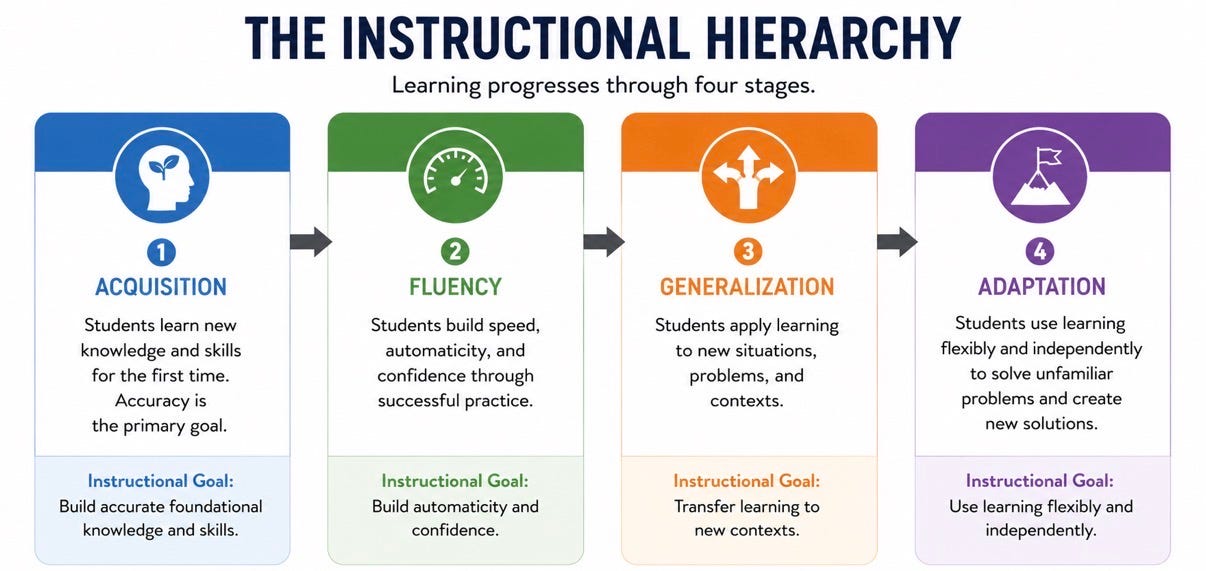
This is one reason I find the Instructional Hierarchy such a useful framework. Developed by Haring and Eaton (1978), the Instructional Hierarchy describes learning as progressing through four stages: acquisition, fluency, generalization, and adaptation. Each stage has a different instructional goal, and understanding those goals can help teachers make better decisions about how to support students as they move from initial learning to independent and flexible application.
At the same time, few instructional frameworks have influenced my practice more than Barak Rosenshine’s Principles of Instruction. Rooted in cognitive science and observations of highly effective teachers, Rosenshine’s principles provide practical guidance for explicit instruction that aligns remarkably well with what we know about how learning happens. What I have come to appreciate, however, is that while many of Rosenshine’s principles can and should be used throughout the learning process, each tends to have its greatest impact at specific phases of the Instructional Hierarchy.
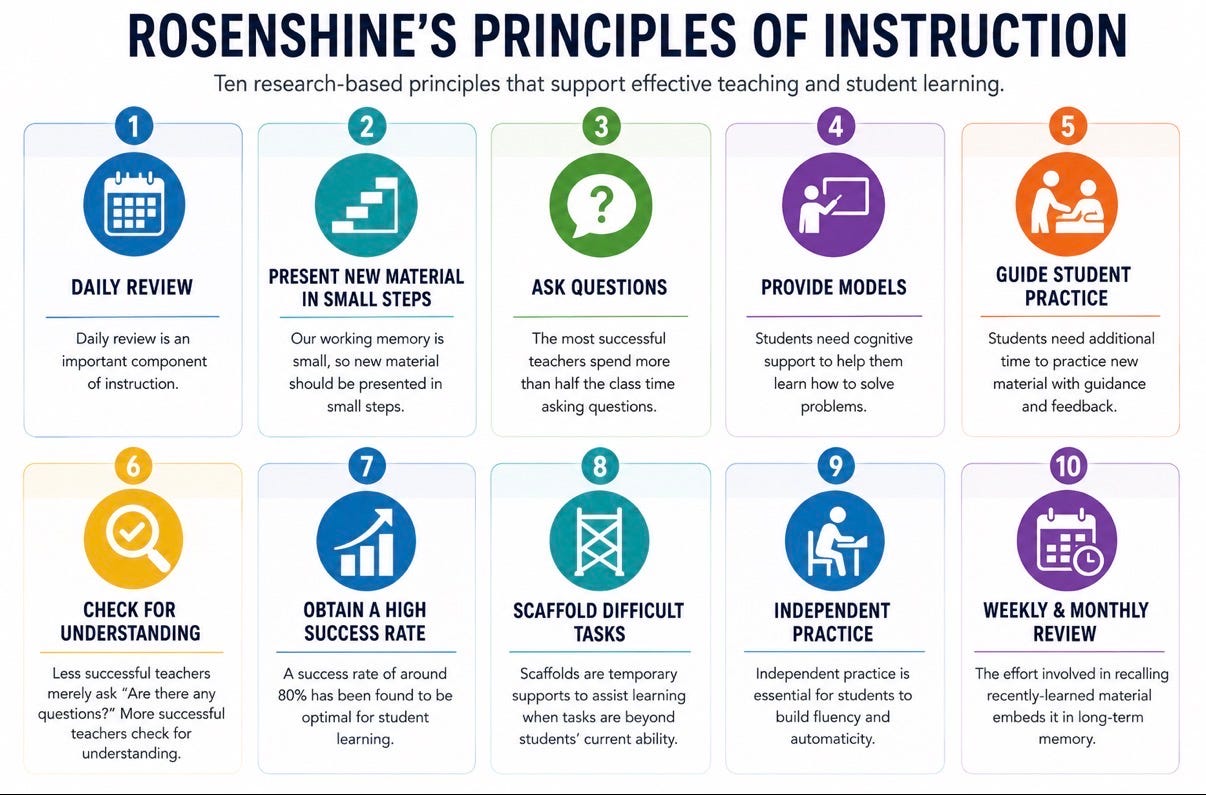
Viewed through this lens, Rosenshine’s principles become more than a list of effective instructional practices. They can be understood as tools that serve different purposes at different points in the learning process. It is important to note that any of Rosenshine’s principles can be effective at any stage of the Instructional Hierarchy depending on the learning goal and context. The alignment presented here is therefore not intended to be prescriptive, but rather to highlight where I believe each principle is likely to have its greatest impact. The sections that follow explore how each stage of the Instructional Hierarchy aligns with particular Rosenshine principles and why those principles may be especially powerful for helping students move from initial learning toward fluent, transferable, and ultimately adaptive use of knowledge. I have also included both example teacher moves and illustrations from a Food Waste case study I teach to show what these principles can look like in practice within a real unit of instruction.
Acquisition Phase: Building Accurate Initial Learning
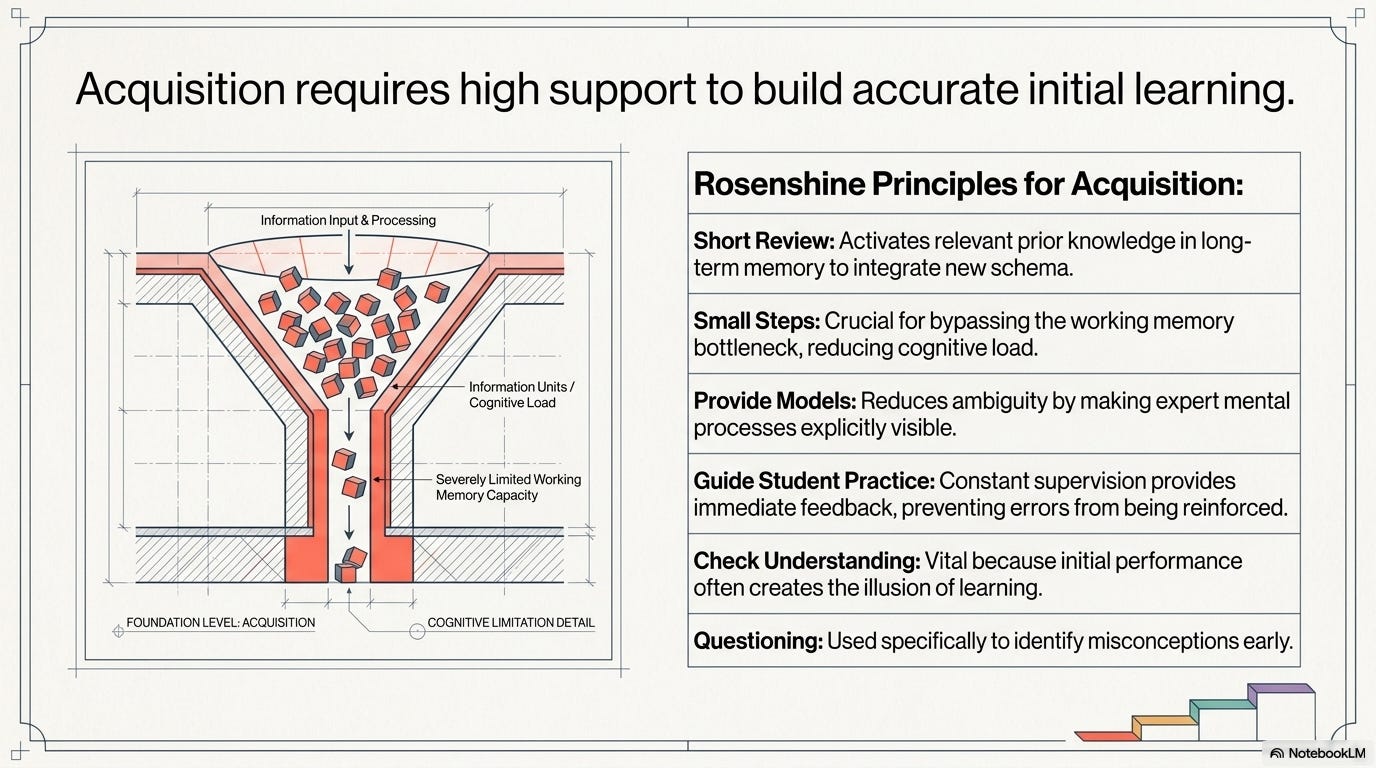
During the acquisition phase, novice students are learning new knowledge and skills for the first time, making accuracy in long term memory the primary instructional goal. Before students can develop fluency, transfer learning to new contexts, or apply knowledge independently, they must first develop accurate knowledge and procedures, which means instruction during this phase should provide explicit guidance and support.
Principle: Begin a Lesson with a Short Review
Beginning a lesson with a short review helps activate relevant prior knowledge in working memory and makes it easier for students to connect new learning to what they already know. Because learning is dependent on existing knowledge, reviewing prerequisite content before introducing new material increases the likelihood that students can successfully integrate new information into their existing schema.
Teacher Move: Begin the lesson with three to five retrieval questions on prerequisite knowledge, such as asking students to recall key vocabulary, concepts, or procedures from previous lessons before introducing new content.
In Practice: Before introducing food waste, students complete a retrieval task recalling prior learning about scarcity, resource allocation, and environmental impacts. Questions might include: “What is scarcity?” and “How can human actions affect the environment?”
Principle: Present New Material in Small Steps
Presenting new material in small steps reflects one of the most important findings from cognitive science: working memory is severely limited. Breaking content into manageable chunks reduces cognitive load and prevents students from becoming overwhelmed while processing unfamiliar information, allowing them to focus their attention on the most important aspects of the new learning.
Teacher Move: Rather than teaching the entire process at once, introduce one step, check understanding, and provide brief practice before moving to the next step.
In Practice: Rather than introducing all aspects of food waste at once, I first teach what food waste is, then explore its causes, followed by its environmental impacts, and finally its economic consequences, checking understanding after each section.
Principle: Ask a Large Number of Questions
Frequent questioning provides opportunities to monitor understanding while ensuring students remain cognitively engaged throughout instruction. During acquisition, questions allow me to identify misconceptions early and make instructional adjustments before misunderstandings become entrenched.
Teacher Move: Use cold calling and mini whiteboards throughout instruction so every student must think about and respond to questions during the lesson.
In Practice: As students examine a graph showing global food waste statistics, I ask questions such as, “What does this graph tell us about the causes of food waste?” “Which region wastes the most food?” and “What trend do you notice?”
Principle: Provide Models
Clear teacher models reduce ambiguity by making expert thinking visible. Students often struggle because they cannot see the mental processes behind successful performance, and effective modeling helps bridge that gap by demonstrating both what to do and how to think while doing it.
Teacher Move: Complete a worked example while thinking aloud, explicitly verbalizing both the steps being taken and the reasoning behind them.
In Practice: I model how to analyze a source by projecting an infographic about food waste and thinking aloud: “I notice that one-third of food produced globally is wasted. This statistic is significant because it suggests food waste is a large-scale problem.”
Principle: Guide Student Practice
Guided practice provides students with the support necessary to apply new learning successfully while it is still fragile. By practicing under teacher supervision, students receive immediate feedback and correction, reducing the likelihood that errors become reinforced through repetition.
Teacher Move: Solve the first few problems as a class, gradually shifting responsibility to students while providing prompts and corrective feedback.
In Practice: After modeling source analysis, we analyze a second source together as a class. I prompt students through identifying key information and drawing conclusions before they attempt the process independently.
Principle: Check for Student Understanding
Checking for understanding is particularly important during acquisition because performance can often create the illusion of learning. Frequent checks allow teachers to verify that students are developing accurate knowledge and skills before moving on to more complex applications.
Teacher Move: Use a hinge question to determine whether students have accurately understood the key learning objective before moving on.
In Practice: Students respond to a hinge question such as: “Which statement best explains why food waste is considered both an environmental and economic issue?” Responses help determine whether additional instruction is needed.
Fluency Phase: Building Automaticity Through Successful Practice
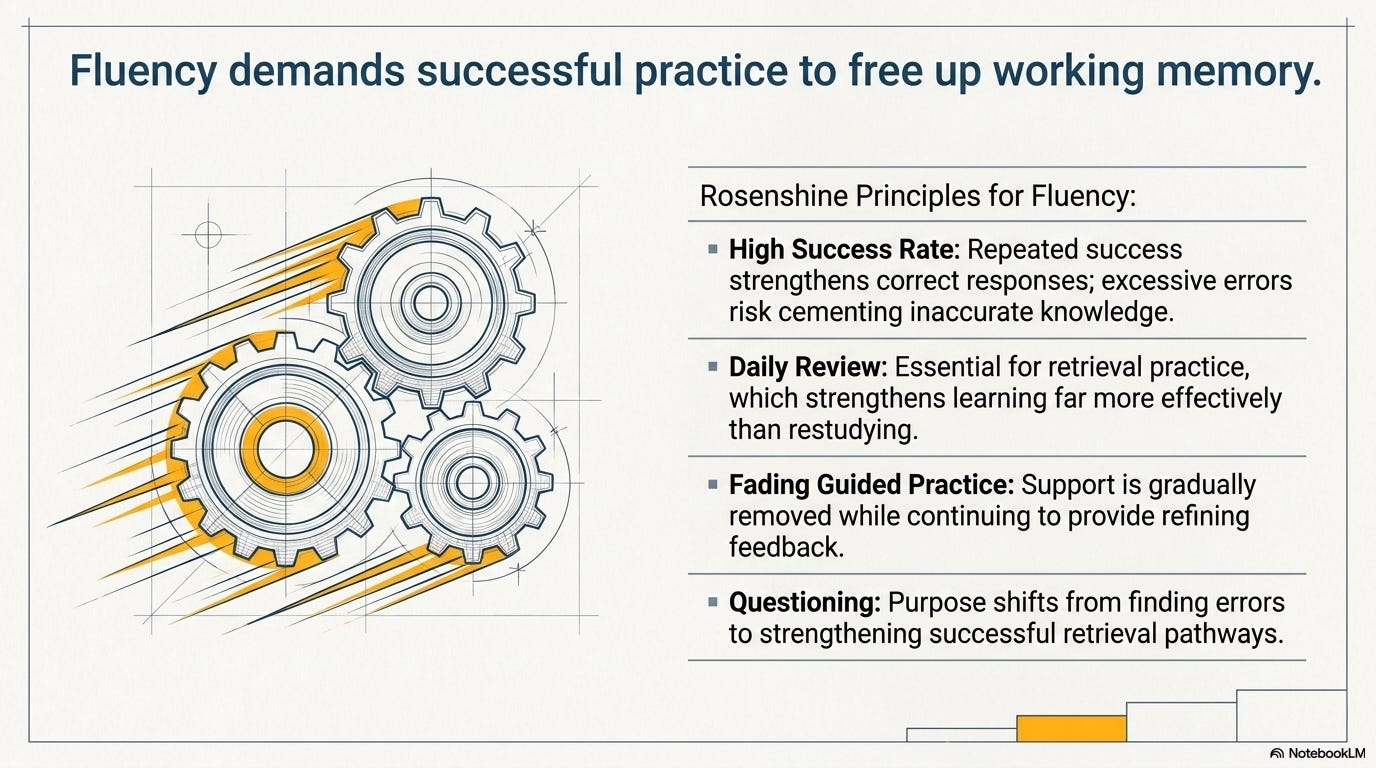
Once students can perform a skill or recall knowledge accurately, the instructional focus shifts toward fluency. At this stage, the goal is no longer simply getting the answer right but increasing the speed, efficiency, and automaticity with which knowledge can be retrieved and applied. As cognitive science has shown, automaticity frees up working memory resources that can then be devoted to higher-order thinking and problem solving.
Principle: Obtain a High Success Rate
Rosenshine emphasized the importance of students experiencing a high level of success during practice, and this principle aligns closely with the fluency stage. Repeated successful performance strengthens correct responses and contributes to the development of automaticity, while excessive errors risk reinforcing inaccurate knowledge and procedures.
Teacher Move: Sequence practice from simple to more complex examples so students can experience repeated successful retrieval and application.
In Practice: Students complete a series of increasingly challenging retrieval tasks on key vocabulary and concepts, such as defining food waste, identifying causes, and explaining impacts, ensuring most students experience success.
Principle: Guide Student Practice
Although students require less support than they did during acquisition, guided practice continues to play an important role during fluency development. Teachers should gradually fade scaffolds while continuing to provide feedback that helps students refine and strengthen their performance.
Teacher Move: Provide partially completed examples or prompts that are gradually removed as students become more proficient.
In Practice: Students practice writing short explanations of food waste impacts using sentence stems and partially completed examples before writing independently.
Principle: Ask a Large Number of Questions
The purpose of questioning begins to shift during this stage from identifying misunderstandings toward strengthening retrieval. Every successful retrieval strengthens memory and increases the likelihood that knowledge will remain secure and automatic in the future.
Teacher Move: Use retrieval questions that require students to recall facts, procedures, or concepts from memory without notes.
In Practice: During retrieval practice, students answer questions such as: “Name two causes of food waste.” “What percentage of food is wasted globally?” and “Why does food waste contribute to greenhouse gas emissions?”
Principle: Daily Review
Daily review may be one of the most powerful principles for supporting fluency because it provides regular opportunities for retrieval practice. Research consistently demonstrates that retrieving information from memory strengthens learning more effectively than simply restudying material, making daily review an essential component of building durable and accessible knowledge.
Teacher Move: Start each lesson with a short retrieval routine that includes questions from the previous lesson, the previous week, and earlier units.
In Practice: Each lesson begins with a five-minute Do Now retrieval routine containing questions from previous lessons and earlier points in the unit. Students regularly revisit key facts, vocabulary, and concepts about food waste.
Generalization Phase: Applying Learning Beyond the Original Context
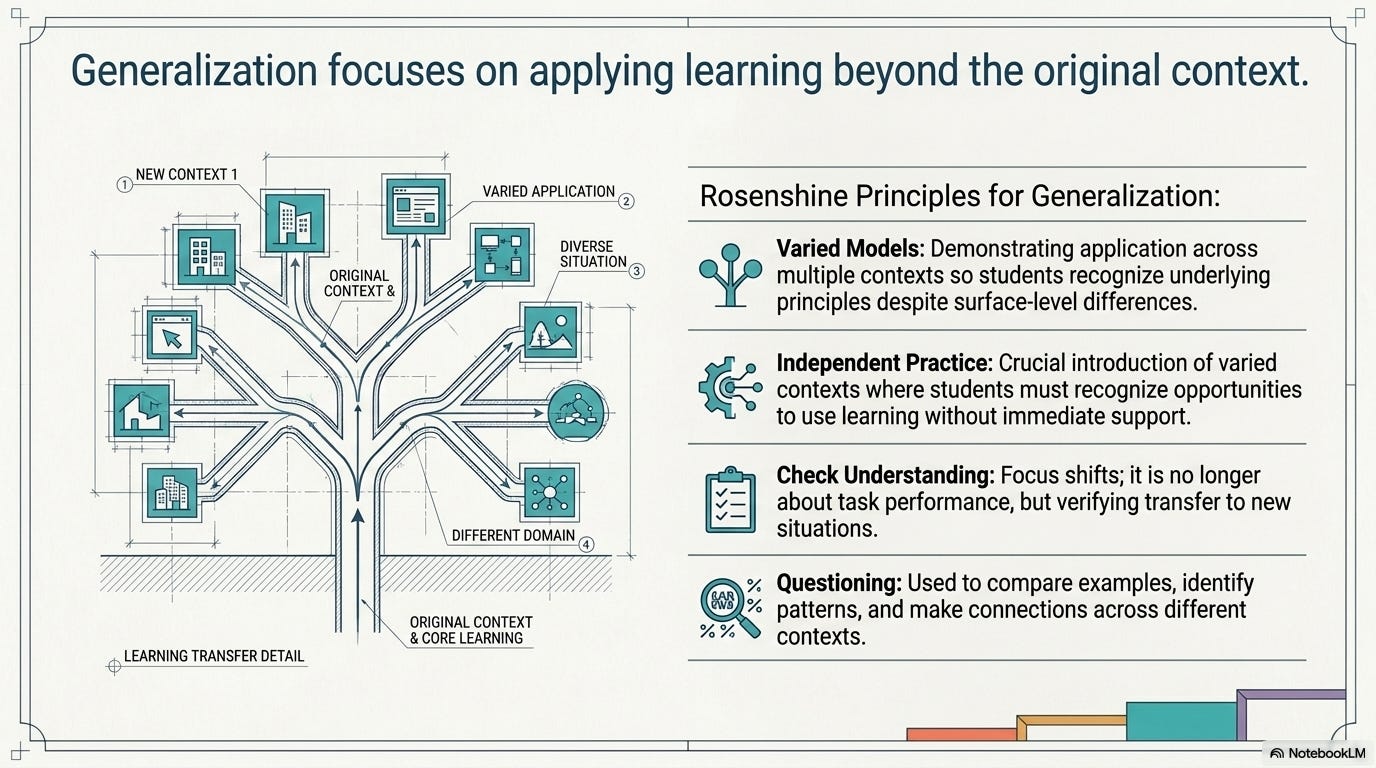
In the generalization phase, students begin learning how and when to apply knowledge and skills beyond the specific contexts in which they were originally taught and learned. This stage is particularly important because success during initial instruction does not necessarily guarantee that students can transfer their learning to new situations, problems, or tasks.
Principle: Provide Models
Modeling remains important during generalization, but the focus shifts toward demonstrating how knowledge can be applied across multiple contexts. By exposing students to varied examples and situations, teachers help students recognize the underlying principles that remain consistent despite surface-level differences.
Teacher Move: Demonstrate how the same concept or procedure can be applied across different examples, contexts, or problem types.
In Practice: Students compare food waste in different countries and discuss questions such as: “What factors might explain these differences?” and “How are the causes similar despite different contexts?”
Principle: Ask a Large Number of Questions
Questions can encourage students to compare examples, identify patterns, explain their reasoning, and make connections across contexts. These processes help students move beyond memorized procedures toward a deeper understanding of when and why particular knowledge should be applied.
Teacher Move Example: Ask students to compare two examples and explain which underlying principle applies in each case and why.
In Practice: Students analyzed proposed solutions to food waste and explain how each solution addresses the underlying causes and effects of food waste.
Principle: Check for Student Understanding
At this stage, checking for understanding is less about determining whether students can perform a task and more about determining whether they can transfer their learning to new situations. Students may appear proficient in familiar contexts while struggling when conditions change, making these checks especially important.
Teacher Move: Present a novel problem and ask students to explain how they would approach it, looking for evidence that they can transfer prior learning.
In Practice: Students analyze a new case study about food waste in a school cafeteria and explain how concepts learned earlier help them understand the problem.
Principle: Independent Practice
Independent practice becomes increasingly important during generalization because students need opportunities to apply learning without immediate teacher support. Practice should include varied contexts and examples that require students to recognize opportunities to use their learning in different situations.
Teacher Move: Assign a set of varied tasks that require students to determine when and how to apply previously learned knowledge without teacher prompting.
In Practice: Students investigate a new example of food waste in grocery stores and independently identify causes, consequences, and potential solutions using the framework developed throughout the unit.
Adaptation Phase: Flexible and Independent Application
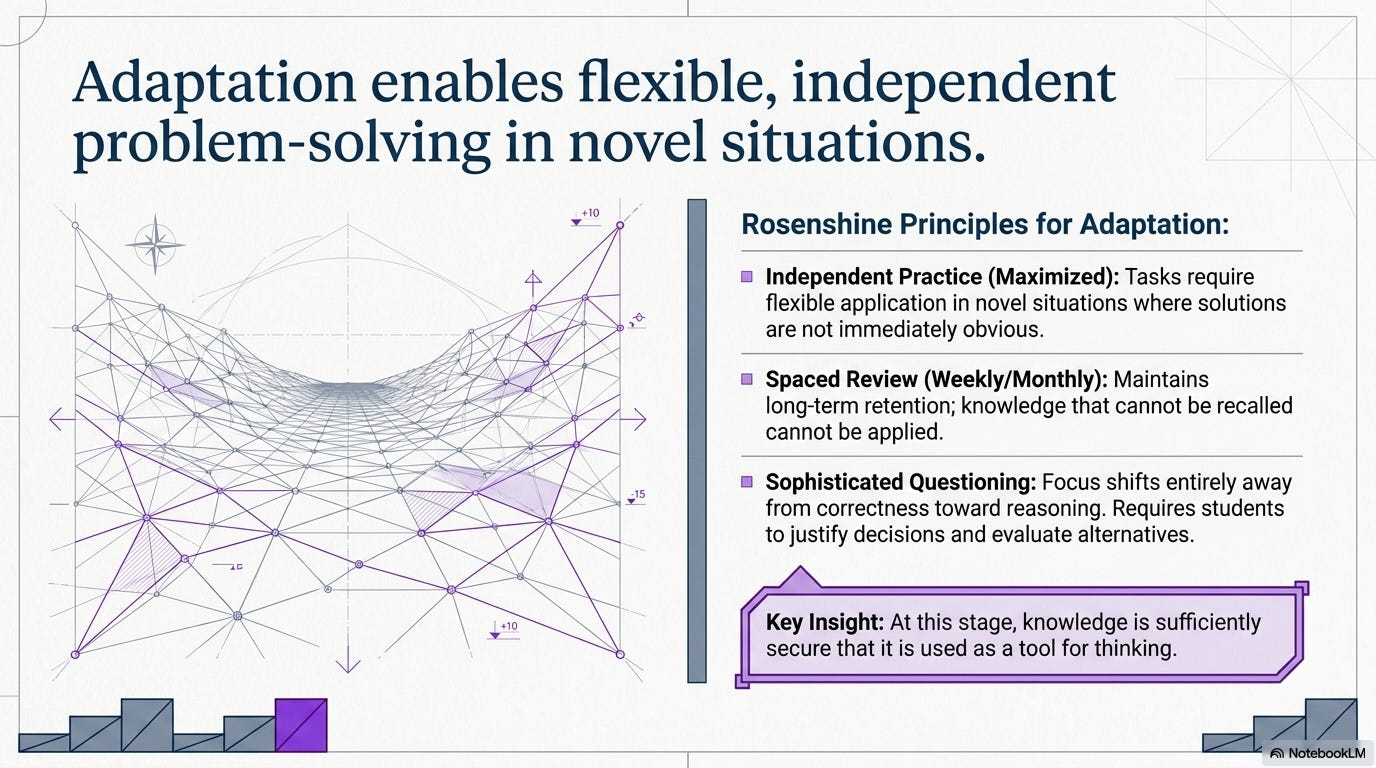
The final stage of the Instructional Hierarchy is adaptation, where students use their knowledge flexibly and independently to solve unfamiliar problems, analyze new situations, and generate solutions that extend beyond anything explicitly taught during instruction. At this point, knowledge has become sufficiently secure and accessible that students can use it as a tool for thinking rather than merely something to be recalled.
Principle: Independent Practice
Independent practice reaches its peak during adaptation because students are expected to demonstrate flexible and independent application of their learning. Tasks at this stage should require students to apply knowledge in novel situations where solutions are not immediately obvious.
Teacher Move: Present students with a complex, unfamiliar problem that requires them to combine multiple pieces of knowledge and select appropriate strategies independently.
In Practice: Students develop their own proposal for reducing food waste in the school cafeteria, drawing upon everything learned throughout the case study while evaluating multiple possible solutions.
Principle: Weekly and Monthly Review
Long-term retention is essential for adaptation because knowledge that cannot be recalled cannot be applied. Rosenshine’s emphasis on weekly and monthly review aligns closely with what we know about spaced practice and the importance of maintaining secure access to knowledge over extended periods of time.
Teacher Move: Include cumulative retrieval activities that revisit content from earlier units.
In Practice: During a later unit on fast fashion, students connect concepts of waste, resource use, and sustainability from the food waste unit.
Principle: Ask a Large Number of Questions
Questioning during adaptation is less focused on correctness and more focused on reasoning. Questions that require students to justify decisions, evaluate tradeoffs, and explain their thinking help students use knowledge in increasingly sophisticated ways.
Teacher Move: Ask open-ended questions such as, “Why did you choose that approach?” or “What might happen if the conditions changed?” to encourage flexible thinking and justification.
In Practice: Students respond to questions such as: “Which intervention would have the greatest impact on reducing food waste and why?” or “How might solutions differ between high-income and low-income countries?” requiring them to justify decisions and evaluate alternatives.
The Importance of Aligning Instruction to Learning
One of the reasons I continue to find both Rosenshine’s Principles of Instruction and the Instructional Hierarchy so valuable is that together they provide a framework for thinking not just about what instructional practices to use but when to use them. Too often educational discussions focus on whether a particular strategy is evidence-informed while overlooking the equally important question of whether it is being used at the right point in the learning process.
Viewing Rosenshine’s principles through the lens of the Instructional Hierarchy has helped me think more carefully about the purpose behind each instructional move. Rather than asking whether a particular practice works, I have found it more useful to ask where students are in the learning process and which practices are most likely to help them progress to the next stage. When we align evidence-informed instruction to where students are developmentally within the learning process, we move beyond simply implementing effective practices and begin using them with the precision that highly effective teaching requires.
Works Cited
Haring, Norris G., and M. Dale Eaton. “Systematic Instructional Procedures: An Instructional Hierarchy.” Exceptional Children, vol. 43, no. 8, 1978, pp. 470–473.
Rosenshine, Barak. “Principles of Instruction: Research-Based Strategies That All Teachers Should Know.” American Educator, vol. 36, no. 1, Spring 2012, pp. 12–19, 39.
I love how many times this piece said, “Ask a large number of questions.” It reinforced what I’ve always thought: Good teachers explain things well. Great teachers ask the right questions.
Mr Benson. Amazing post, as always. I want to use this approach, too. But, I was looking to get the instructional hierarchy article you cite and I can't find it. Is there any chance you could share it with me? Thanks in advance. Love your substack entries, and x tweets about the science of learning and explicit teaching. Big fan.