Cognitive Mentor vs. Experiential Guide: A Rosenshine-Inspired Comparison

Deep down, most teachers are all the same. We want our students to learn deeply, think independently, and apply knowledge flexibly. But how we get there is where we tend to disagree. Much of this difference in philosophy depends on what we individually believe about how learning works best.
Some teachers act as Experiential Guides, grounded in constructivist theory. They prioritize exploration, inquiry, and student-led discovery. Their lessons often begin with open-ended questions or projects designed to immerse students in real-world tasks. They believe learning happens best when students actively construct knowledge through experience, with the teacher as a facilitator, not a director, of that learning.
Others embrace the role of Cognitive Mentor, informed by cognitive science and instructional research. They believe learning is a change in long-term memory, and that novices need clear explanations, modeling, scaffolding, and guided practice to build accurate schema. Their job is to support student thinking explicitly, gradually transferring responsibility as understanding deepens.
I’ve studied both. I’ve used both. But after reading Rosenshine’s Principles in Action by Tom Sherrington and Rosenshine’s original 2010 article, combined with what I know about the science of how we learn, I’ve become convinced: for students to learn effectively we must be Cognitive Mentors.
A Brief History of the Principles
Barak Rosenshine, a professor of educational psychology at the University of Illinois, synthesized findings from three key areas of research :
Cognitive science
Master teachers
Cognitive supports
The result was his “Principles of Instruction”, a clear, research-backed guide to high-impact classroom practices. The 10 principles highlight how the best teachers break down complex material, check for understanding, scaffold thinking, and support students until they can work independently with confidence and accuracy.
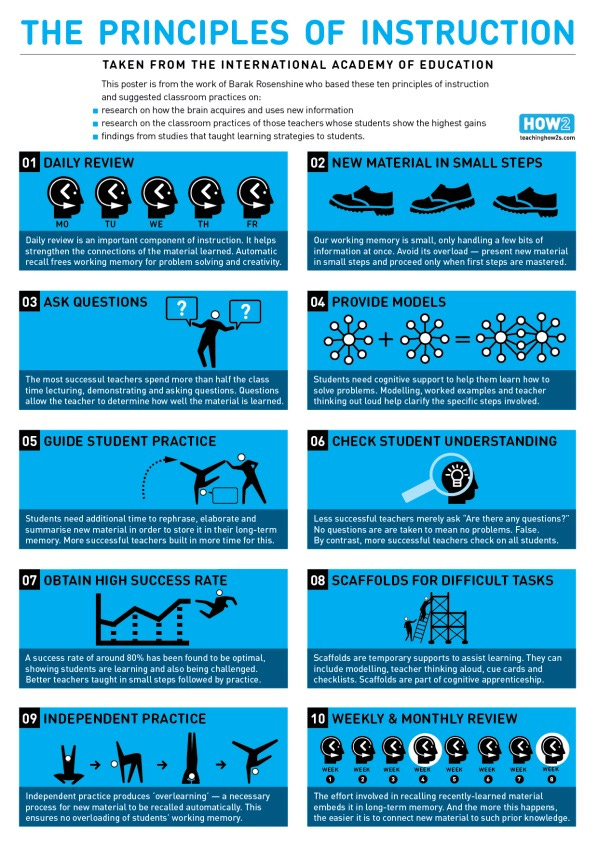
What follows is a comparison of how an Experiential Guide and a Cognitive Mentor might approach each of Rosenshine’s 10 Principles of Instruction, and why one approach gives students a better shot at deep, durable learning.
The 10 Principles: A Comparison
1. Daily Review
Experiential Guide: May begin with a general question like “What do you remember?” or skip review entirely in favor of jumping into a new task. Assumes knowledge will resurface when needed.
Cognitive Mentor: Begins with retrieval-based prompts to reactivate prior learning and reduce cognitive load. Emphasizes the need to bring key knowledge back into working memory before adding new layers.
2. Present New Material in Small Steps
Experiential Guide: Tends to introduce whole problems or projects, encouraging students to figure out the steps on their own. Emphasizes independence and complexity early on.
Cognitive Mentor: Carefully sequences learning in manageable chunks. Each step is modeled, checked, and rehearsed before moving on. Supports working memory and avoids overload.
3. Ask a Large Number of Questions and Check All Responses
Experiential Guide: Often relies on open-ended questions and volunteer responses. May miss what students actually understand.
Cognitive Mentor: Uses cold calling, mini whiteboards, and probing follow-ups. Prioritizes full participation and visible thinking. Encourages students to rehearse knowledge to build and refine schema.
4. Provide Models
Experiential Guide: Often delays or skips modeling to avoid “giving away” the answer. Assumes struggle leads to deeper understanding.
Cognitive Mentor: Models early and often. Narrates thinking processes, provides worked examples, and links abstract concepts to concrete examples. Prevents misconceptions before they form.
5. Guide Student Practice
Experiential Guide: Assigns independent tasks quickly. Assumes students will learn by doing and that reflection afterward will clarify confusion.
Cognitive Mentor: Stays in the “we do” phase longer. Guides students through structured rehearsal, asking probing questions and offering feedback. Builds accuracy, confidence, and independence.
6. Check for Student Understanding
Experiential Guide: May assume understanding from apparent engagement or lack of questions. Uses informal observation.
Cognitive Mentor: Designs routines for checking understanding (whiteboards, oral rehearsal, paired explanations). Doesn’t ask “Do you understand?”, asks, “What have you understood?” Surfaces misconceptions and addresses them immediately.
7. Obtain a High Success Rate
Experiential Guide: May view frequent errors as signs of effective exploration. Believes students learn from struggle, even when success is limited.
Cognitive Mentor: Aims for ~80% success during guided practice. If success is too low, reteaches, remaps, and rebuilds understanding before advancing. Avoids encoding errors into long-term memory.
8. Provide Scaffolds for Difficult Tasks
Experiential Guide: Encourages independence early and often. May avoid scaffolding to preserve student ownership of learning.
Cognitive Mentor: Uses sentence starters, writing frames, guided outlines, and visual supports. Scaffolds are temporary but intentional, helping students do now what they’ll be able to do later on their own.
9. Require and Monitor Independent Practice
Experiential Guide: May treat independent work as an opportunity for exploration. Monitoring is light; autonomy is the focus.
Cognitive Mentor: Structures independent tasks with clear expectations and criteria. Circulates, gives feedback, and ensures students are practicing correctly, not reinforcing misunderstandings.
10. Engage Students in Weekly and Monthly Review
Experiential Guide: Long-term review may happen incidentally or through final projects. There’s little intentionality behind spacing or retrieval.
Cognitive Mentor: Uses spaced retrieval, cumulative quizzes, and elaborative questioning to keep knowledge alive. Reinforces schema and ensures knowledge sticks.
Why I Choose to Be a Cognitive Mentor
In a profession full of well-meaning approaches, we must ask the most important question: What actually works?
The Experiential Guide approach sounds attractive. It promises autonomy, creativity, and authentic engagement. But when tested against decades of research, from classroom studies to cognitive psychology, it comes up short. Why? Because it misunderstands how novices learn based on our cognitive architecture.
Novice learners don’t think like experts. They can’t intuit complex ideas from rich experiences without support. They need structure, modeling, rehearsal, and feedback. Without it, they flounder, overwhelmed by tasks that exceed their cognitive capacity and unsure what success even looks like.
Rosenshine’s principles, and the research behind them, make it clear: learning is a change in long-term memory. That change doesn’t happen through exploration alone. It happens through explicit instruction, scaffolded thinking, guided practice, and deliberate review.
Cognitive science reinforces this approach. Research on working memory, schema formation, and cognitive load shows that novices cannot handle complex tasks without guidance. Their limited working memory is easily overwhelmed when too much information is presented at once or when tasks lack clear structure. But when teachers provide explicit instruction, model thinking, and scaffold complexity, students are more likely to encode accurate knowledge into long-term memory and retrieve it when needed.
This is how learning sticks. A cognitive mentor doesn’t leave thinking to chance. They design learning processes that reflect how the brain actually learns.
This is the work of the Cognitive Mentor:
We model how to think and what to notice.
We break complex ideas into teachable chunks.
We check what students understand, not just what they do.
We use every tool available, examples, questions, scaffolds, retrieval, to build accurate, connected schema.
We don’t assign and hope. We teach, and we adjust.
It’s not less creative. It’s not robotic. It’s not controlling.
It’s responsible, responsive, and research-aligned.
So I choose to be a Cognitive Mentor. Because that’s who students need to really learn.
References
Agarwal, Pooja K., and Patrice M. Bain. Powerful Teaching: Unleash the Science of Learning. Jossey-Bass, 2019.
Jones, Kate. Retrieval Practice: Research and Resources for Every Classroom. John Catt Educational, 2019.
Kirschner, Paul A., and Carl Hendrick. How Learning Happens: Seminal Works in Educational Psychology and What They Mean in Practice. Routledge, 2020.
Lovell, Oliver. Cognitive Load Theory in Action. John Catt Educational, 2020.
Rosenshine, Barak. Principles of Instruction: Research-Based Strategies That All Teachers Should Know. International Academy of Education, 2012.
https://www.aft.org/sites/default/files/periodicals/Rosenshine.pdf
Sherrington, Tom. Rosenshine’s Principles in Action. John Catt Educational, 2019.