
Eureka: A Practitioner Knowledge System for Evidence-Based Teaching

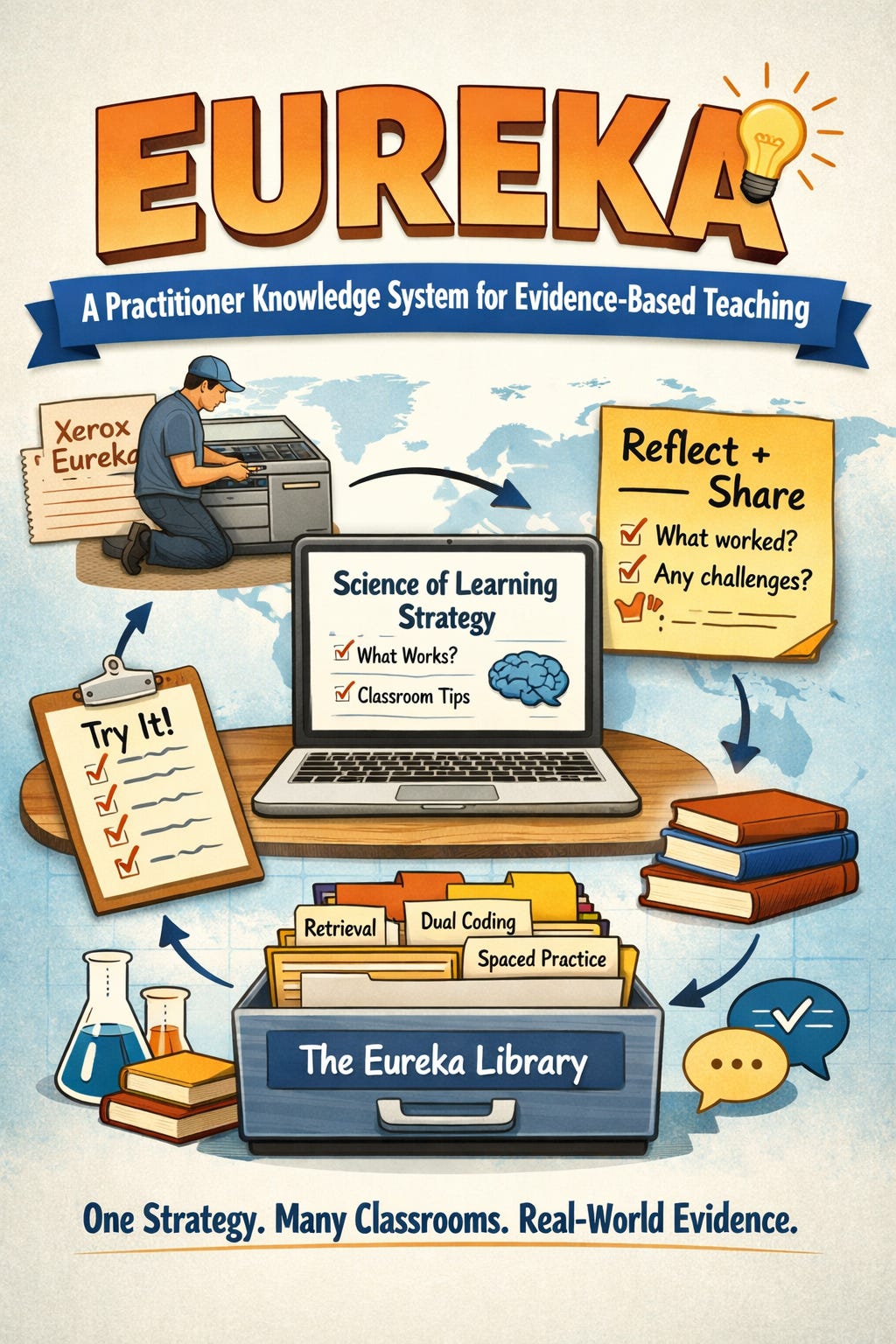
In the 1990s, Xerox faced a problem that will feel familiar to many teachers. The company had invested heavily in formal training, documentation, and expert-designed manuals, yet its photocopier technicians were still encountering problems the official materials didn’t adequately address. What Xerox eventually realized was simple but transformative: the most valuable knowledge wasn’t missing. It just wasn’t being shared.
Technicians were solving problems every day in the field. They were developing workarounds, noticing patterns, and refining solutions through experience. But that knowledge lived in isolation. Xerox’s response was Eureka, a system that allowed technicians to document and share what actually worked in real situations. Over time, this practitioner-built knowledge base outperformed formal documentation, improved efficiency, and reduced repeated failures. Xerox didn’t replace research or training. It amplified it by capturing practice.
Education is facing a remarkably similar challenge.
The science of learning has given us a strong research base. Thanks to cognitive science, we know far more than we once did about how memory works, how novices learn, and why strategies like retrieval practice, spacing, worked examples,and explicit instruction are effective. That knowledge is widely available. What remains scarce is visibility into how those strategies are actually being used by teachers in real classrooms, with real students, under real constraints.
Too often, teaching practices are discussed abstractly. We read about them, attend sessions on them, and debate them on social media. But we rarely see systematic, cross-context sharing of what happens after teachers try them. The result is that much of the field’s most valuable knowledge, teacher learning through practice, is never documented.
All of this led me to a light-bulb moment: a Eureka system for capturing and sharing what educators are learning from using evidence-based practices grounded in the science of learning.
Here’s my vision.
Eureka will be a practitioner knowledge system for evidence-based teaching. Educators focus on one research-backed strategy at a time, try it in their classrooms, and share their reflections publicly, then come together regularly in a virtual space to make sense of what we’re seeing across contexts.
This system would bring the logic of Xerox’s Eureka system to educators on Substack and elsewhere. The is goal to build a public, practitioner-driven knowledge system for evidence-based teaching. A place where educators can use research-backed strategies, reflect honestly on what happened, and share those insights so others can learn from them.
The general idea for a structure is this: Each month, one evidence-based instructional strategy is communicated through my Substack. The post explains what the strategy is, why it works according to cognitive science, and where it is commonly misunderstood. From there, educators are invited to try the strategy in their own classrooms in whatever way fits their context. The emphasis is on practice, not perfection.
Throughout and by the end of the month, participants are encouraged to share a short reflection. What did they try? What worked? What didn’t? What would they do differently next time and moving forward?
These reflections, lessons, student examples, videos, etc., are collected and organized into a Eureka Library—a living, open database of practitioner knowledge accessible to educators around the world. It captures what teachers are learning as they apply evidence-based strategies in real classrooms. These entries aren’t polished exemplars; they are practical reflections on what was tried, what supported learning, and what challenges emerged.
The library will be searchable and organized by strategy, grade level, subject area, and instructional features, making it easier for educators to find examples that match their context. Over time, it grows into a shared record of practice, one that complements research by showing how evidence-based practices actually function in practice, across many classrooms and conditions.
What distinguishes Eureka from traditional professional learning is its orientation toward practice over performance. In fact, the most valuable contributions are often the imperfect ones. When teachers can see how others adapt the same strategy across different grades, subjects, and student populations, research becomes more usable and less abstract.
At its core, Eureka is built on a simple belief: research does not improve teaching by itself. Teachers do. And teachers learn fastest when the focus is narrow, the strategy is grounded in evidence, and the learning is shared laterally rather than delivered top-down. Xerox learned that its best problem-solvers weren’t just experts. They were practitioners willing to share what they had found. Education needs the same system.
Eureka is an invitation to make evidence-based teaching public. To move beyond discussing what should work and start documenting what does. One strategy at a time, across many classrooms, building shared knowledge that actually travels.
There’s more to come. In the weeks ahead, I’ll share additional details about how Eureka will work and how educators can participate. For now, this is simply an introduction and an outline of the idea and the possibility.
Who is with me?

I would love to contribute. It sounds like a great project.
I think one key is humility. My experience is that translating research into practice is hard and involves lots of failures. There's been a strong market over the last decade for folks sharing their successes with cognitive science and evidence in education. I know my students would have benefited if I had more chances to see the failures, all the stuff people tried that didn't work, and managed to avoid a few of them myself. I wonder what types of design principles can encourage that sort of sharing.
Fantastic idea. As someone attempting to implement SoL work in isolation, this is exactly what I’m missing.