Instructional Simplicity as a Learning Science Principle

Below is a photo I took before students walked into my classroom one morning this week. It shows a simple setup: a desk, a visualizer, an outline map, and a pen. No stations. No gallery walks. No task cards. No pre-staged activities. Just a clean workspace and a clear plan.
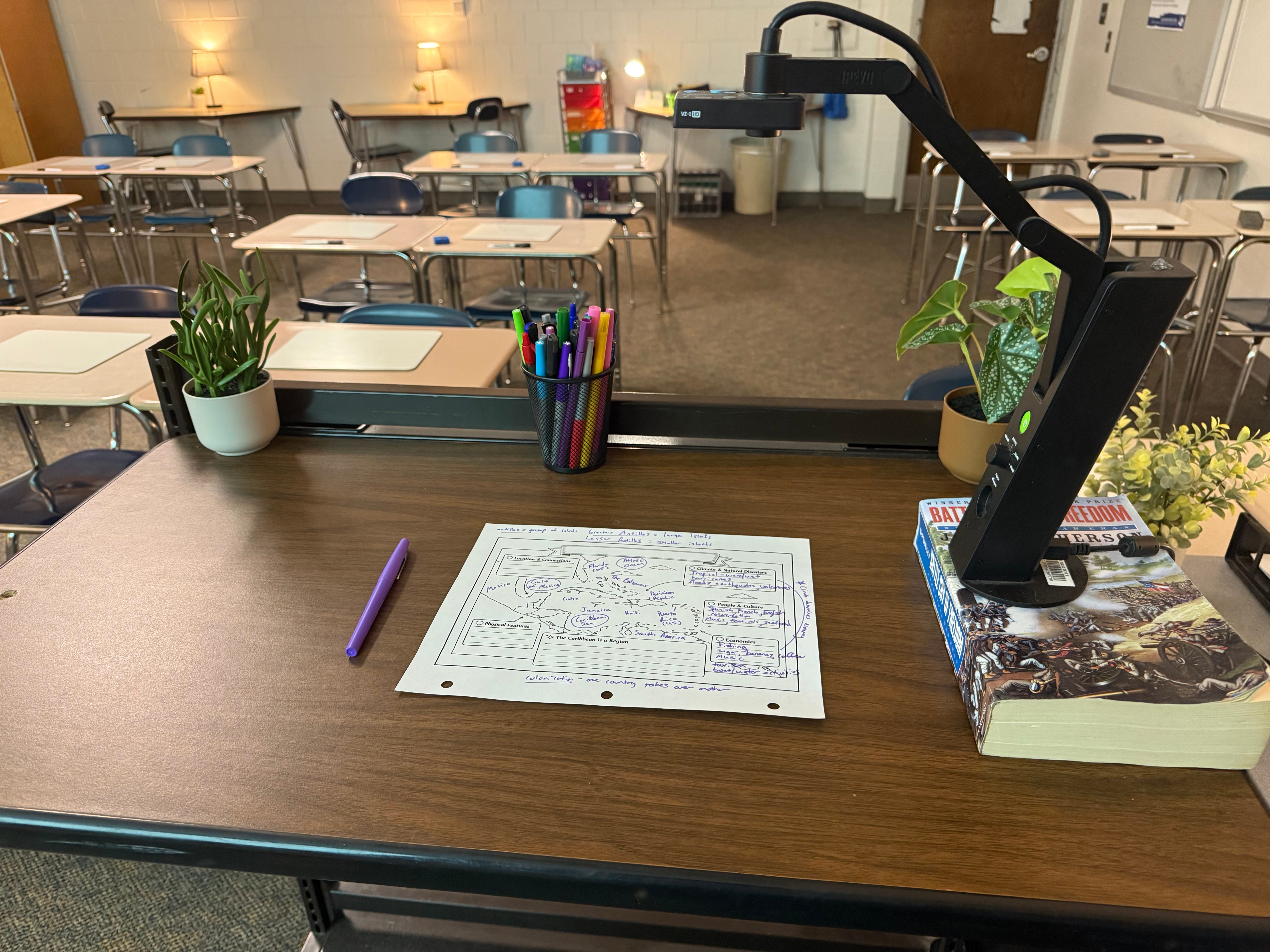
That simplicity wasn’t accidental. It was instructional design.
In previous years, this same Caribbean geography lesson would have been built as a high-energy, activity-based experience with stations, rotations, games, layered structures meant to produce visible “engagement.” It would have looked dynamic and impressive from the outside. But from a cognitive perspective, it was inefficient and ineffective. Too much student working memory would have been spent navigating procedures, transitions, materials, and novelty rather than processing the content itself.
Cognitive Load Theory helps explain why. Learning is constrained by the limits of working memory. When instruction introduces unnecessary complexity, it increases extraneous cognitive load, the mental effort that does not contribute to learning, and can cause cognitive overload. When extraneous load is high, it competes directly with the cognitive load required to build schemas and long-term memory.
In other words, students aren’t failing to learn because they aren’t engaged. They’re failing to learn because their working memory is saturated with extraneous details and distractions.
This lesson, as all of mine are, was designed around the opposite principle: minimize extraneous load and optimize working memory so cognitive load can be devoted to learning new information.
The content was broken into intentionally small, coherent chunks—islands, bodies of water, climate, natural resources, economy, culture. All explained as building blocks of critical content with nuanced relevance to one another and not as isolated sets of facts about a place and people. I used think alouds to make expert knowledge visible and accessible, so students weren’t forced to infer meaning while also trying to learn new information. Each chunk was processed immediately before moving on. The pacing was brisk, but tightly controlled, reducing dead time and attentional drift without creating cognitive overload.
After every instructional chunk, students responded. Continuously. Purposefully.
Choral response created low-risk rehearsal and collective retrieval.
Turn-and-talk forced verbal processing and elaboration.
Cold calling ensured individual accountability and diagnostic checking.
Show calls surfaced student thinking publicly and shared knowledge building
Active observation allowed for real-time instructional adjustment based on student understanding
These moves were all about cognitive processing. They created repeated opportunities for retrieval, rehearsal, and encoding, which cognitive science identifies as essential for durable learning.
Nothing in the lesson design was accidental. Every structural decision was filtered through one question: Does this support learning, or does it compete with it?
This is the real meaning and elegance of simplicity in instruction.
Not simplicity as minimal effort.
Not simplicity as low rigor.
Not simplicity as reduced expectations.
But simplicity as cognitive efficiency.
By stripping away unnecessary layers, transitions, and novelty, students’ working memory was optimized. Attention was harnessed. Cognitive effort was directed toward meaning-making instead of task management.
This aligns directly with cognitive load research: when extraneous load is reduced, learners have more capacity to engage in schema construction. Learning becomes more durable, more transferable, and more stable over time.
Teaching explicitly and simply is a scientifically grounded design principle:
It respects the limits of working memory.
It aligns with how knowledge is encoded.
It supports long-term retention.
It increases transfer.
Often the most powerful learning environment doesn’t look impressive from the hallway. It looks like a piece of paper, a visualizer, a teacher modeling thinking, and a classroom structured around small chunks, frequent responses, deliberate rehearsal, and continuous feedback.
That’s simplicity, not as a slogan or buzzword, but as a learning science design principle.
I love that you are writing about this. There is such a huge difference in instruction. As a student coach, and a parent of an incredibly intelligent, neurodivergent young adult, I pay attention to how teachers present their material, in order to help my child and other students possibly avoid situations and professors who don’t get it (at the college level where there is more choice). You can tell a lot from their introductory emails, their syllabus and the first assignment. I’ve seen the range of beyond disastrous for neurodivergent brains (this is an immediate drop the course and take something else if possible) to extremely neuro-affirming presentation and instruction (take as many courses from this instructor as you can).
Thank you for the very practical example of what it looks like to apply learning science to an actual lesson.